
A profile of the Zürcher Weinland municipality
Berg am Irchel: the village, its history and life in the Zurich Wine Country
Berg am Irchel is a small, picturesque village in the district of Andelfingen. It is situated on the banks of the Irchel, forms part of the Zurich Wine Country, and combines a high quality of rural living with history, community life, regional culture, nature, and easy access to the Rhine, the Thur floodplains and other day-trip destinations.
Berg am Irchel at a glance
Berg am Irchel is situated in the Zurich wine-growing region on a terrace overlooking the Irchel. The municipality belongs to the district of Andelfingen and, in addition to Berg, also includes the hamlet of Gräslikon. Its location between the Irchel, the Rhine and the Thurauen makes the village scenically attractive whilst also ensuring it is well integrated into the region.
Its defining features include the historic village centre, the vineyards, its proximity to woodland and farmland, and a vibrant community life. Berg am Irchel is therefore not just a place to live, but also part of a cultural landscape in which agriculture, viticulture, nature and history are closely intertwined.
| Characteristic | Classification |
|---|---|
| Canton / District | Zurich, Andelfingen district |
| Districts | Berg am Irchel and Gräslikon |
| Landscape | Irchel, vineyards, woodland, open farmland and proximity to the Rhine and the Thur floodplains |
| Character | A small wine-growing village with a historic townscape, local businesses and a vibrant community life |
| Well-known places | The Bird of Prey Centre, Berg Castle, Eigenthal Castle and Ebersberg Fortress in the surrounding area |
History and townscape
The first documented mention of Berg am Irchel dates back to 1243. At that time, the village was referred to as Mountains mentioned. As early as the 13th century, jurisdiction, ecclesiastical rights and structures of power were an important part of the town’s history.
In the Middle Ages, the rights to Berg were held by ecclesiastical and noble institutions. Following the Reformation, key rights were transferred to Zurich. In the 17th century, Berg am Irchel became the seat of its own bailiwick court. This development explains why, despite its small size, the town boasts a remarkably rich historical heritage.
Gräslikon is now part of the political municipality of Berg am Irchel. The village was founded in the 13th century as Grassilincon was mentioned and, following a long period of development, became part of the municipality of Berg am Irchel. It is important to note that, in today’s municipal landscape, Berg and Gräslikon together shape the identity of the municipality.
The coat of arms of Berg am Irchel
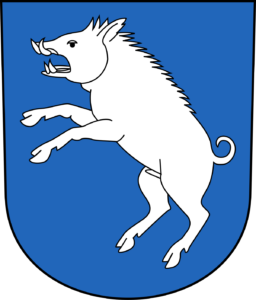
The municipal coat of arms features a leaping silver boar on a blue background. The design dates back to the Lords of Erzingen-Bettmaringen, who held feudal rights in Berg during the Middle Ages. It was adopted as the official municipal coat of arms in 1943.
The coat of arms is therefore more than just a decorative symbol. It reflects the area’s medieval history of rule and links the modern-day municipality with its regional past.
Historical sights and places of interest
For such a small community, Berg am Irchel boasts several notable historical and cultural landmarks. Some are located right in the village, whilst others are in the surrounding area. It is important to note that not all of these sites are freely accessible; some are privately owned or can only be visited as part of a guided tour.
Berg am Irchel Castle
Berg Castle was built in 1649 by Hans Heinrich Escher vom Luchs. The complex stands on the edge of the village centre and continues to shape the historic townscape to this day. It is privately owned and is significant primarily as a building and a historical landmark.
More about Berg CastleEigenthal Castle
Eigenthal Castle dates from 1588 and is characterised by the late Gothic style. This property is also privately owned. Together with Berg Castle, it demonstrates that Berg am Irchel has a richer historical heritage than the size of the municipality would suggest.
More about Eigenthal CastleEbersberg Fortress
Ebersberg Fortress was built between 1938 and 1940 as an artillery fortification. Its purpose was to make it more difficult or to delay any crossing of the Rhine in the event of war. Today, it is an important site in Zurich’s military history.
More about Ebersberg FortressBerg am Irchel Bird of Prey Centre
The Bird of Prey Centre was founded in 1956 and is now part of the PanEco Foundation. It cares for injured, weakened or orphaned birds of prey and owls, and carries out important work in the areas of animal care, environmental education and species conservation.
More about the bird of prey stationNature, Irchel and places to visit
The Irchel river shapes the landscape of Berg am Irchel. Woodland, vineyards and open spaces combine to form a typical wine-growing cultural landscape. For walkers, cyclists and nature lovers, the village is an excellent starting point for trips towards the Irchel, the Rhine and the Thurauen.
Its proximity to various natural and recreational areas is particularly valuable: the Thur floodplains, the Rhine, the wooded hills of the Irchel and the wine-growing villages are all close by. This makes Berg am Irchel ideal for short walks as well as longer hikes and cycle tours.
Suitable destinations in the area
- Irchel High-Altitude Trails: Wooded paths offering views of the surrounding area and quiet stretches away from major roads.
- Thurauen: A significant natural area featuring floodplain countryside, opportunities for wildlife watching and a nature centre.
- The Rhine near Flaach and Rüdlingen: A local recreational area for walks, nature watching and day trips.
- Zurich Wine Country: A region renowned for its vineyards, historic villages, cycle routes and local produce.
Wine-growing, gastronomy and regional produce
Berg am Irchel is situated in the Zurich wine country. Vineyards and winegrowing are therefore an integral part of the character of the village and the surrounding region. Local businesses, restaurants and wineries help to ensure that the village is recognised not only for its scenic beauty but also for its culinary delights.
For visitors, the regional connection is important: viticulture, agriculture, gastronomy and village culture are not separate spheres here, but part of the same landscape. Those who visit the municipality experience the wine-growing region best via footpaths, viewpoints, local businesses and seasonal cuisine.
Traube Restaurant
A restaurant with a regional focus. For current opening hours and the menu, please check the restaurant’s website directly.
Traube RestaurantThe Economy and Viticulture at the Wine Press
Combining gastronomy and viticulture. Such establishments are important for regional identity and for visitors who wish to experience the Zurich wine country through its cuisine.
To the wine pressBaur Winery
A regional winery with strong links to the cultural landscape of the wine-growing region. Ideal for visitors who wish to discover local wines directly from the region.
Baur WineryMilestone Wines
Another winery in the region. Up-to-date information on the range, tastings and special offers can be found directly at the winery.
Milestone WinesClubs, events and village life
Village life in Berg am Irchel is strongly shaped by clubs, local events and voluntary work. For a small community, this vibrant club scene is a key factor in its appeal: it brings people together, keeps traditions alive and ensures that village life remains vibrant.
Community life includes, amongst other things, shooting clubs, music, traditional costume groups, nature conservation, sports and leisure activities, as well as other regional organisations. Clubs are particularly important in small communities, as they bring people together across generations and interests.
Infrastructure, education and the economy
Berg am Irchel is a small town, but it boasts important local and regional facilities. These include the local council, utilities, waste management, schools, a library, regional transport links and local businesses. For residents, this information is often more important than tourist guides.
The municipality is integrated into regional structures. In terms of education, Berg am Irchel is part of the Flaachtal school district. Waste collection, sewage services, public transport and other services are also partly organised at a regional level. This is typical of small municipalities in the Zurich Weinland region and helps to ensure that everyday life runs smoothly.
| Area | Relevance for residents and visitors |
|---|---|
| Local authority | A one-stop shop for services, public authorities, finance and local information. |
| School | Integration into Flaachtal School, with educational provision organised at a regional level. |
| Supply | Local water and heating supplies form part of the municipal infrastructure. |
| Commercial | Local businesses in the sectors of agriculture, viticulture, crafts, healthcare, catering and services. |
| Public transport | Connections via regional timetables operated by ZVV, SBB and PostAuto. |
Useful links to the local area and region
Opening hours, events, guided tours, timetables and administrative information are subject to change. You should therefore always check the official websites of the local authority and the relevant providers for the latest information.
A small town with a rich regional heritage
Berg am Irchel is not a large municipality, but it is a place with a remarkably rich history and regional significance. Castles, coats of arms, a bird of prey sanctuary, Ebersberg Fortress, vineyards, the Irchel Forest and a vibrant community life all demonstrate just how diverse the municipality is within such a small area.
Anyone who visits or lives in Berg am Irchel experiences a slice of the Zurich wine country that should not be reduced to individual sights. The charm of the place lies in the interplay of landscape, history, village life, regional connections and voluntary work.
 Deutsch
  Français
  Italiano
  English (UK)