
The Swiss Army’s new service pistol
SIG Sauer P320: Swiss Army opts for new service pistol despite controversy
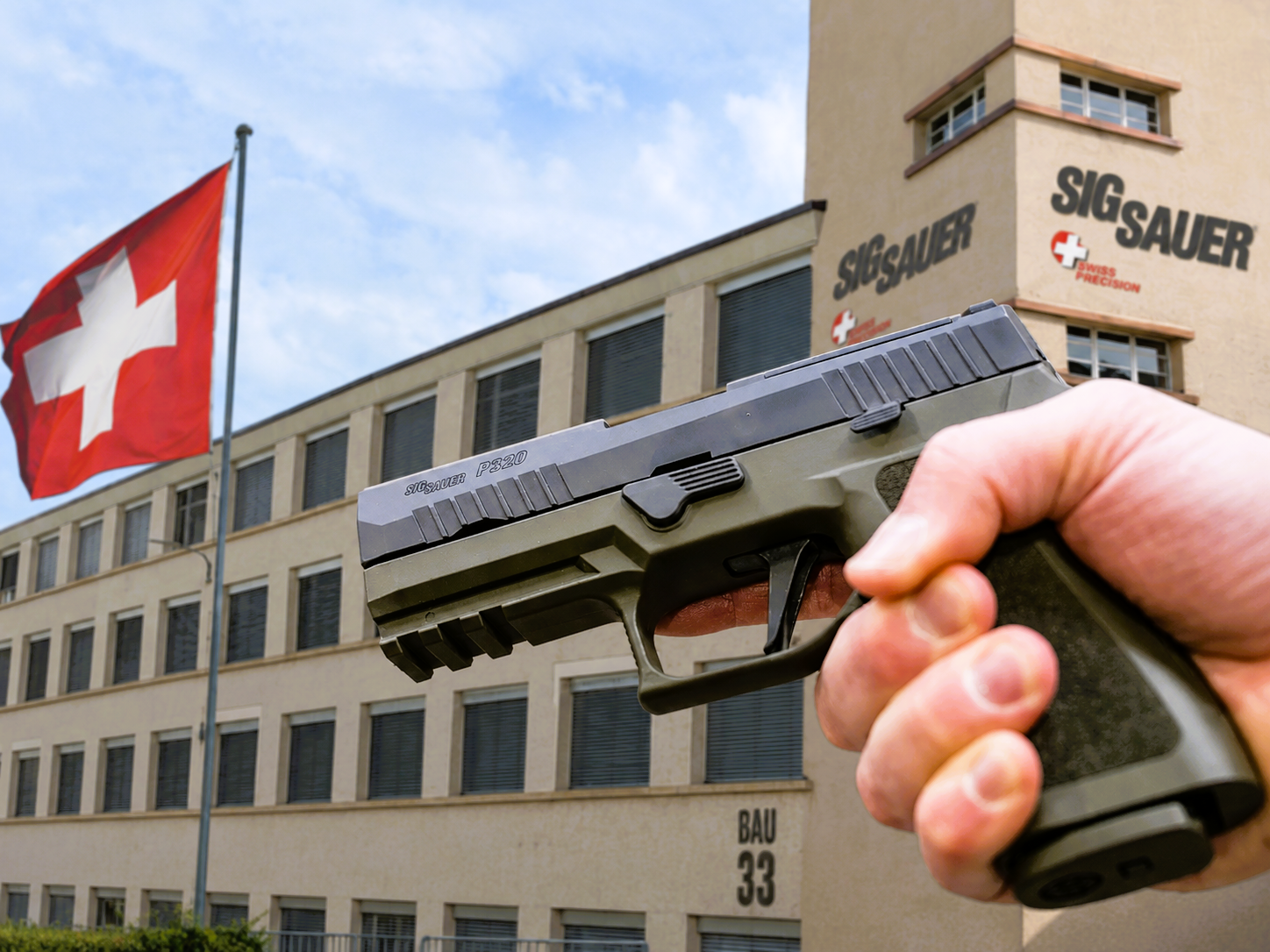
The choice of model is a politically and procurement-wise contentious issue: in future, the Swiss Army is to be equipped with the SIG Sauer P320 be equipped with. At the same time, the pistol has been the subject of international criticism for years. From the Swiss perspective, the decisive factors were not only technology and safety, but also cost, security of supply and the establishment of production in Switzerland.
A decision with far-reaching political implications
The Swiss Army is replacing the tried-and-tested Pistol 75. That in itself would be a major procurement. However, the decision has caused a stir due to the choice of SIG Sauer P320: A modern, modular service pistol that is in widespread use around the world, yet is also the subject of international controversy .
The decision is remarkable: Switzerland has opted for the P320, even though the platform has repeatedly been the subject of safety debates in the US and internationally. Armasuisse justifies its choice of model on the basis of an overall assessment of costs over the entire service life, safety-related tests, potential modifications and the planned production in Switzerland.
What armasuisse has decided
The Federal Office for Defence Procurement (armasuisse) has completed the evaluation of the new service pistol and the SIG Sauer P320 has been selected as the future model. The procurement is being carried out as part of the project 9mm pistol CH A NG and is set to replace the current 75 pistol.
The in-depth evaluation examined three pistols: the Glock G45 Gen 5, the Heckler & Koch SFP9 and the SIG Sauer P320. All three systems underwent technical trials, field trials and logistical testing.
It is particularly noteworthy that, according to the official statement, only the Glock G45 met all the mandatory criteria and was classified as suitable for military use. The P320 was nevertheless awarded the contract because the overall assessment, taking into account defence policy, economic and strategic factors, favoured SIG Sauer.
- Requirements: The Swiss Army expects to receive a total of 140,000 new service pistols.
- First instalment: Army Message No. 26 is to be used to request 50,000 pistols.
- Useful life: The assessment was carried out with a view to around 30 years of operation.
- Total cost: According to the evaluation report, the P320 has the lowest lifetime costs.
- Production: Significant parts of the production process are to be established in Switzerland.
The controversy surrounding the P320
The P320 is not an unknown platform. It has been widely used internationally for years, including by the military, government agencies and police forces. At the same time, there have been reports, investigations and debates surrounding alleged accidental discharges. These discussions have also featured in the Swiss procurement decision.
SIG Sauer strongly refutes the allegations. The manufacturer maintains that the P320 complies with international safety standards and that it is technically impossible for a shot to be fired accidentally without the trigger being pulled. As evidence, SIG Sauer cites extensive testing by military and police authorities, as well as the continued use of the platform by numerous agencies.
The Swiss decision will depend on how armasuisse assesses the results of its own tests. According to a government statement, the P320 met all safety-related requirements during technical testing. According to the official account, the weaknesses identified relate to issues that can be rectified, such as Ergonomics and Component robustness.
What sets the SIG Sauer P320 apart
The P320 is a modern, modular pistol platform chambered in 9 mm. Its design differs significantly from older service pistols: at its heart lies a modular system in which the grip, configuration and operating concept can be adapted to different requirements.
It is precisely this modularity that is important for an army. A service pistol must not only be accurate and reliable on paper; it must also be possible to train personnel in its use, maintain it, repair it and adapt it to different user groups over the course of decades.
Modularity
The P320 platform allows for a variety of grip and configuration options. For the Swiss Army, this adaptability is particularly important, as ergonomic features are specifically re-evaluated following troop trials.
Long-term care
Given a planned service life of around 30 years, spare parts, maintenance, documentation and training are at least as important as the pistol itself.
International use
The P320 is in service with military and police organisations worldwide. This speaks to its broad industrial base, but does not replace the specific Swiss retraining programme.
Swiss series standings
The final Swiss configuration is not simply a standard model from the catalogue. It is to be adapted and tested in accordance with the requirements of the Swiss Army.
Manufacturing in Switzerland: The key strategic factor
A key reason for choosing the P320 is the guarantee that it is manufactured in Switzerland. SIG Sauer intends to continue production at the site Neuhausen am Rheinfall expand production and work with Swiss suppliers in accordance with the manufacturer’s specifications. This is not just about a pistol, but about security of supply, supply chains and domestic industrial expertise.
The manufacturer refers to a technology transfer for the P320 and the establishment of a Swiss manufacturing base. The aim is to manufacture and maintain relevant components in Switzerland and ensure their long-term availability. According to the manufacturer, the production line is being set up; full approval depends on the required documentation, acceptance tests and certification.
- Location: Neuhausen am Rheinfall is to be developed as a manufacturing hub.
- Supply chain: Swiss suppliers are to be involved in the supply of components, services and maintenance.
- Supply: The army wants to reduce its reliance on foreign supply chains for security-related equipment.
- Value creation: SIG Sauer highlights Switzerland’s high level of value creation and existing industrial expertise.
Ergonomics, grip and upskilling
The P320 was not selected without conditions. armasuisse states that the identified areas for improvement must be addressed. In particular, the following are mentioned: Ergonomics and Component robustness. The manufacturer has given an assurance that it will implement these technical and ergonomic adjustments.
In practical terms, this means that the future Swiss Army pistol is unlikely to simply be a standard model already in use. Following the troop trials, adjustments are to be made to handling, grip position, feel and durability. Particularly with a service pistol used by a very diverse range of army personnel, ergonomics is no minor detail.
Why the ergonomics of the handle are crucial
A pistol must be safe, intuitive and reliable to use. Grip angle, hand position, accessibility of controls and control whilst firing influence training, safety and accuracy. If the army requests adjustments following troop trials, this is therefore not a cosmetic issue, but a practical outcome of actual use.
Project status: What has been confirmed and what remains to be resolved
| Full stop | Classification |
|---|---|
| Selection of type | The SIG Sauer P320 has been selected as the new service pistol. |
| Retest | Ergonomics and component durability need to be improved and tested. |
| Production | Establishing production in Switzerland is a key requirement and forms part of the overall assessment. |
| Certification | The production and post-qualification stages must pass the required tests. |
| Delivery | According to the project, delivery to the army is scheduled to begin in 2028. |
From the classic Pistole 75 to a modular platform
The previous 75 pistol is based on the SIG P220 and represents a different generation of service pistols: classic, robust, tried and tested, and in service for decades. The P320, on the other hand, marks the move towards a modern, modular platform.
This change affects more than just the weapon itself. Training, spare parts, holsters, magazines, documentation, maintenance and non-firing training pistols must also be taken into account. This is precisely why armasuisse lists not only the pistols but also other operational and training equipment.
| Area | Pistol 75 | SIG Sauer P320 |
|---|---|---|
| Generation | A classic service pistol from the 1970s | Modern modular service pistol platform |
| Role | The Swiss Army’s tried-and-tested standard pistol | Successor model in the CH A NG 9mm pistol project |
| Procurement | Existing system with established logistics | New system covering production, training and maintenance |
| Industry | With strong historical ties to the Swiss SIG tradition | To be implemented using Swiss manufacturing and suppliers |
What the decision means for the armed forces and industry
The choice of the P320 is a procurement decision with multiple dimensions. From a technical perspective, the aim is to provide the army with a modern, long-term service pistol. Logistically, it involves training, spare parts, maintenance and supply over decades. In terms of industrial policy, it concerns Swiss manufacturing and security-related expertise.
That is precisely where the real significance of the decision lies. Switzerland could have based its decision purely on technical suitability. Instead, it opted for a solution that will require retrofitting, but which offers advantages in terms of cost, strategic supply and domestic production.
This makes the decision understandable, but not without its challenges. The P320 must now prove that the promised modifications work, that Swiss production meets the required standards, and that the new service pistol meets the army’s expectations in both training and operational use.
Analysis: A bold choice of cast, with some tests of their mettle still to come
The SIG Sauer P320 is to become the Swiss Army’s new service pistol. The decision is significant because it bolsters Swiss industry and prioritises long-term security of supply. At the same time, it is a sensitive one because the P320 is the subject of international controversy and the Swiss version still has to undergo further certification.
What will therefore be decisive is not just the contract award, but the implementation: Swiss production, certified manufacturing, ergonomic adjustments, robust components and a smooth integration into training and the troops. Only then will it become clear whether the controversial choice of model will result in a viable army system for the coming decades.
 Deutsch
  Français
  Italiano
  English (UK)